


Anisotropic Modified Cam-Clay (AMCC)
For normally consolidated or lightly overconsolidated soils, the coefficient of lateral earth pressure at rest, K0 < 1, used in the K0 procedure defines an inherently anisotropic initial stress state. However, most constitutive models, including the Modified Cam-clay (MCC) model, assume an initially isotropic stress state and account for stress anisotropy only through the imposed initial stress conditions. Furthermore, most practical applications, particularly those involving staged construction, entail changes in the stress ratio relative to its initial value. Consequently, the role of anisotropy extends beyond the initial geostatic stress state and remains relevant throughout the subsequent loading history. A constitutive model that explicitly accounts for stress-induced anisotropy is therefore more appropriate for such applications. To address this need, the GEO5 FEM program implements the Anisotropic Modified Cam-clay model (AMCC), originally presented in [1], as a smooth alternative to the well-established Sekiguchi–Ohta model [2].
The required material parameters are essentially the same as used in the formulation of the Modified Cam-clay model including the stress dependend stiffness that evolves with the effective mean stress σm as

where κ is the so called κ-modulus and ein is the initial void ratio. If not explicitely prescribed, the value of ein is provided by

where λ is the so-called λ-modulus, and pcin is the initial preconsolidation pressure, typically defined such that the initial geostatic stress σin satisfies the adopted yield condition. Note that e0 represents the void ratio corresponding to pc0 = 1 and can therefore be regarded as a material parameter, unlike ein, which depends on the current state of the soil. For certain combinations of the input parameters e0, κ, and λ and the initial geostatic stress, represented by pcin and σmin, the resulting value of ein may be negative. In such cases, ein is set to zero. Conversely, a value of ein > e0 should not occur. Further details can be found either in section devoted to the Modified Cam-clay model or in the Theoretical manual.
A graphical representation of the yield surface projected onto the meridian and deviatoric planes is shown in the following figure. Unlike the MCC model, the AMCC model employs the Matsuoka–Nakai yield surface formulation in the deviatoric plane, similarly to the Generalized Cam-clay model.
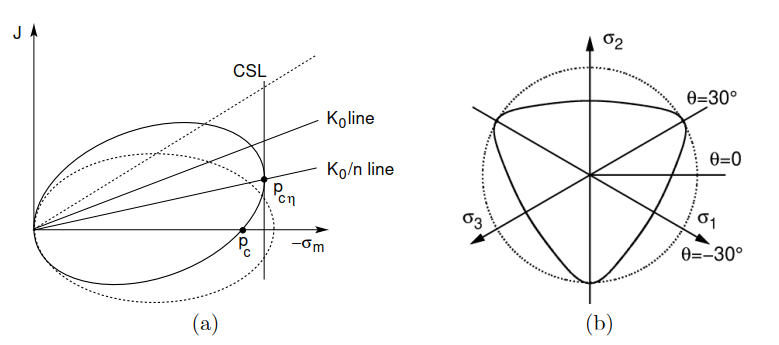 a) Projection of MCC (dashed line) and AMCC (solid line, isotropic hardening along the K0/n-line) models in meridian plane, b) Shape of MCC (dashed line) and AMCC (solid line) models in deviatoric plane
To obtain the rotated yield surfaces of the Anisotropic Modified Cam-Clay model, corresponding to hardening along a specific K0/n-line, the authors of [1], following the approach of the Sekiguchi and Ohta model [2], introduced the relative stress ratio η as

where sij0, σm0 are the deviatoric stresses and the effective mean stress at the end of the anisotropic K0 consolidation. The mathematical formulation of the yield surface then receives the following form

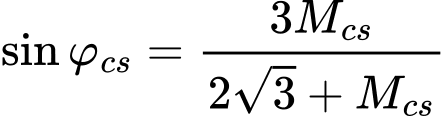
where s, J, σm, and θ denote the current deviatoric stress vector, equivalent deviatoric stress, effective mean stress, and Lode angle, respectively. The quantities s0, J0, and σm0 represent the corresponding stress measures in the initial geostatic state established by K0–consolidation. The matrix Q is a diagonal operator matrix; see the Theoretical manual for details. Point out that setting K0 = 1 and g = Mcs, where Mcs is the slope of the critical state line (CSL), reduces the AMCC formulation to the standard Modified Cam-clay model. The critical state friction angle, φcs, is calculated from the input value of Mcs, assuming triaxial compression, as follows
It is evident from the above discussion that the AMCC model can be activated in the first or second calculation stage only if the K0 procedure is used to establish the initial geostatic stress state.
The safety factor analysis follows the same procedure as that described for the Modified Cam-clay model. However, this option is available only if running the stability analysis within a given construction stage.
A simple example of a drained triaxial compression test is presented in the following figure for illustrative purposes. The figure compares the results obtained using the MCC (dashed lines) and AMCC (solid lines) models, with both models employing a single quadrilateral axisymmetric element. In the first calculation stage, the specimen was consolidated using the K0 procedure, with K0 = 0.5 and a maximum initial vertical stress of σv0 = 100 kPa. In the second stage, the vertical stress was increased until the soil reached the critical state, characterized by no further accumulation of volumetric plastic strain. As shown in figure (b), the two models predict markedly different responses. In particular, the AMCC model exhibits greater stiffness and predicts a higher ultimate vertical stress, reaching σvmax ≈ 208 kPa, compared with σvmax ≈ 172 kPa for the MCC model. These differences are further illustrated by the evolution of the yield surfaces for the two models, shown in figure (a). Further details including the adopted material parameters can be found in [3] and the Theoretical manual.
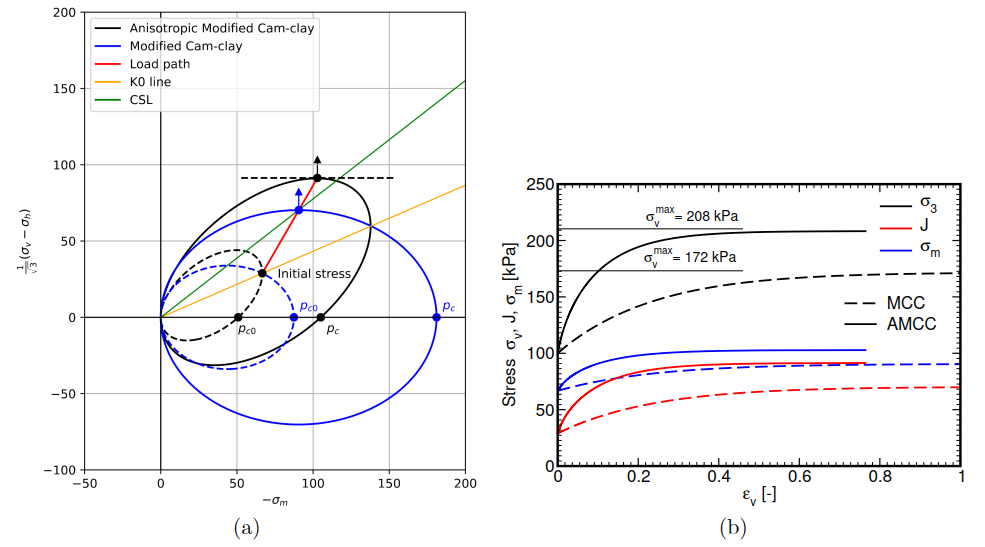 a) Initial and final yield surfaces, b) Evolution of vertical σv, equivalent deviatoric (J) and mean (σm) stress measures as a function of vertical strain
[1] K. Zhang and Yingbo Ai. Comparison and application of different elasto-plastic constitutive models in FEM analysis of an excavated soil slope. Journal of civil engineering and management, 18(6):802–810, 2012.
[2] H. Sekiguchi and H. Ohta. Induced anisotropy and time dependency in clays. In S. Murayama and A.N. Schofield, editors, Proc. of Specialty Session 9th International Conference on Soil Mechanics and Foundation Engineering, pages 229–238. Japanese Society of SMFE, 1977.
[3] M. Šejnoha, A. Zemanová, B. Polák, T. Janda. Application of Anisotropic Modified Cam-clay model in the modeling of selected geotechnical structures.