

Verification according to CSA S16:24
Check for shear
The shear capacity is conservatively determined as the capacity of the steel section itself.
Compression and bending check for concrete filled circular hollow sections
The factored compressive resistance of a composite section is given by:
![]()
where:
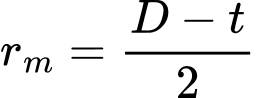
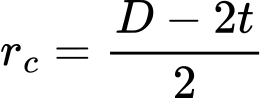
![]()
![]()
![]()
![]()
where: | φ | steel load-bearing capacity coefficient |
φc | concrete load-bearing capacity coefficient | |
Aa | area of steel cross-section | |
Ac | area of concrete | |
Fy | steel yield stress | |
fc' | specified compressive strength of concrete | |
L | height of sheeting | |
D | outside diameter of circular hollow section | |
t | thickness of circular hollow section |
The moment resistance of a composite cross-section is given by:
![]()
where:
![]()
![]()
![]()
![]()
Utilization is determined by:
![]()
where: | β | coefficient for bending |
M | design bending moment | |
N | acting design axial force | |
γ0 | angular position of the neutral axis |
fc | compressive strength of concrete |
Check for compression for other cross-sections
The factored compressive resistance of a composite section is given by:
![]()
The utilization ratio is determined by:
![]()
Check for bending
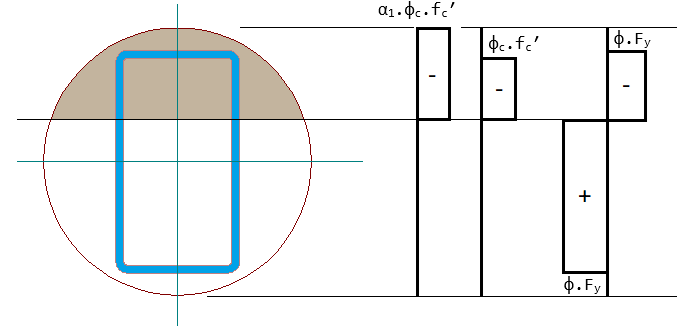
The moment resistance of a composite cross-section is determined from the interaction diagram. The bearing capacity of Mrc is considered with the influence of the compressive force. It is assumed that the concrete does not act in tension, there is a plastic stress distribution on the steel and concrete, like on the picture below. The strength α1 . φc . fc' is assumed for the concrete outside the steel section, and the strength φc . fc' is assumed for the concrete inside the steel section.
Utilization ratio is given by:
![]()